
When And How To Say No To Job Interview Projects

Among the more controversial aspects of hiring right now is when companies assign projects for job candidates to complete. These “tests” are typically one of the final steps of the hiring process, and the assignments can vary in scope.
We’re not talking about personality assessments, either. Companies will assign projects that closely resemble the tasks of the job that the candidate is applying for.
On the flip side, candidates are becoming frustrated by taking hours to complete projects when:
- It’s unclear how many other candidates they’re up against for the job
- They’re not being compensated for their time
- The work can be used by the company even if the candidate is not hired
- They don’t know the consequences of saying no or pushing back on the request
The Complete Interview Guide for Today’s Hiring Process covers where a step like this fits into a stronger overall process.
Austin Jobs Group
This topic surfaced recently on the Austin Digital Jobs Facebook group.
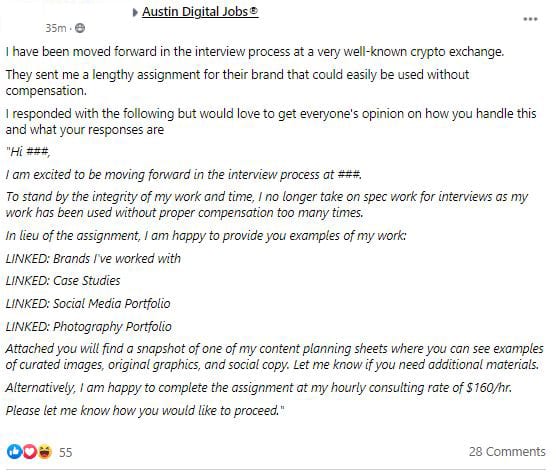
Why We Do Not Like Job Interview Projects
These are the reasons why we think hiring projects are problematic for both sides.
- Reveals a larger issue: If a company must use projects to evaluate candidates, it indicates that they can’t gauge applicants accurately using traditional methods. This tells us that they’re either being lazy or ineffective in other parts of the hiring process.
- Reputational risk: When companies go overboard relative to the complexity of the projects that they assign, it’s exploitative. It feels like free consulting to candidates, who leave with a bad taste – i.e. if this is what they ask me to do for free, I wonder what they’ll ask me to do once they’re paying me.
- It can backfire: Competition for talent is extremely high. If your company requires candidates to complete projects, but other companies that candidates are considering do not, guess who’s at a disadvantage?
- Only tells part of the story: Projects do not tell a complete story about a candidate, so companies need to be careful how much weight they assign to a project. For instance, projects have little relevance to management roles, which require leadership skills, collaboration, and interaction.
- Does it work both ways? There’s a give-and-take to hiring processes, and projects are one-sided. Would the hiring managers who request projects from candidates do the same thing in return (i.e. complete a project so the candidate can tell if they’re a good supervisor)? Probably not.
- Open to manipulation: Companies who hail the merits of projects are naive if they think candidates can’t get outside help to improve their performance. So assigning projects can create an uneven playing field.
An exception to these rules is when tech companies assign candidates coding exercises. These often are given to individual contributors, and we see these as important to evaluate how proficient someone knows a coding language.
Even these tests can go out of bounds, though, if companies ask for a real deliverable or for something that takes an inordinate amount of time to finish. How to Evaluate Company Culture Before You Accept an Offer looks at other signals worth weighing alongside this one.
How To Push Back on Job Interview Projects
Job interview projects likely won’t go away anytime soon. Candidates must decide how badly they want the job before completing a test or project.
If the deliverable could be used for real work, protect it. Ask the company to sign an NDA. Free NDA templates are available online.
It’s fair to ask a company to compensate you for your time. Don’t expect them to say yes, though. This is especially true for high-demand jobs where other candidates may do the work for free.
Ultimately, it’s best to have alternatives. That way, you won’t feel pressured to complete a project because your options are limited. How to Prepare for an Interview: What Recruiters Want You to Know has more on walking into these conversations ready to negotiate.
Related Articles
- The Complete Interview Guide for Today’s Hiring Process
- Interview Preparation Checklist: Everything to Do Before Your Interview
- How Candidates Should Handle A Multiple-Offer Scenario
- Finding Conviction During The Hiring Process